Use Cases and Applications for AI Agents
Today, AI can help you get work done (LLMs) and they can also get work done for you (AI agents). This changes how work is performed across personal and organisational contexts, replacing manual coordination with delegated execution. In this blog we’ll look at the various use cases and applications for AI agents.
What Is an AI Agent
An AI agent is a software system designed to perceive inputs, make decisions, and execute tasks.
It operates with varying levels of autonomy depending on its design and constraints. Some agents follow strict rules. Others adapt based on data and context. The defining capability is action.
AI agents integrate across tools, data sources, and platforms. They are not limited to a single interface. They move across systems to complete tasks end to end.
This marks a transition away from chat-based interaction. The primary function becomes execution rather than conversation.
What Are AI Agents Used For
AI agents are deployed wherever tasks can be structured, repeated, and optimised.
They automate repetitive digital work such as data entry, scheduling, and content distribution. They manage workflows that span multiple systems, reducing the need for manual handoffs.
They make decisions based on data inputs, from simple rule-based triggers to more complex evaluations. In many cases, they act on behalf of individuals or organisations, carrying out instructions without constant supervision.
Benefits of AI Agents
Efficiency
AI agents reduce time spent on repetitive tasks. They enable multiple workflows to run in parallel, increasing output without increasing effort.
Scalability
Agents handle increased workload without proportional cost increases. They operate continuously, without downtime, allowing processes to run beyond human working hours.
Consistency
Tasks are executed with defined logic. This reduces variability and enforces standardised processes across operations.
Cost Reduction
Routine processes require less manual labour. Operational overhead is optimised as agents take on repetitive and structured work.
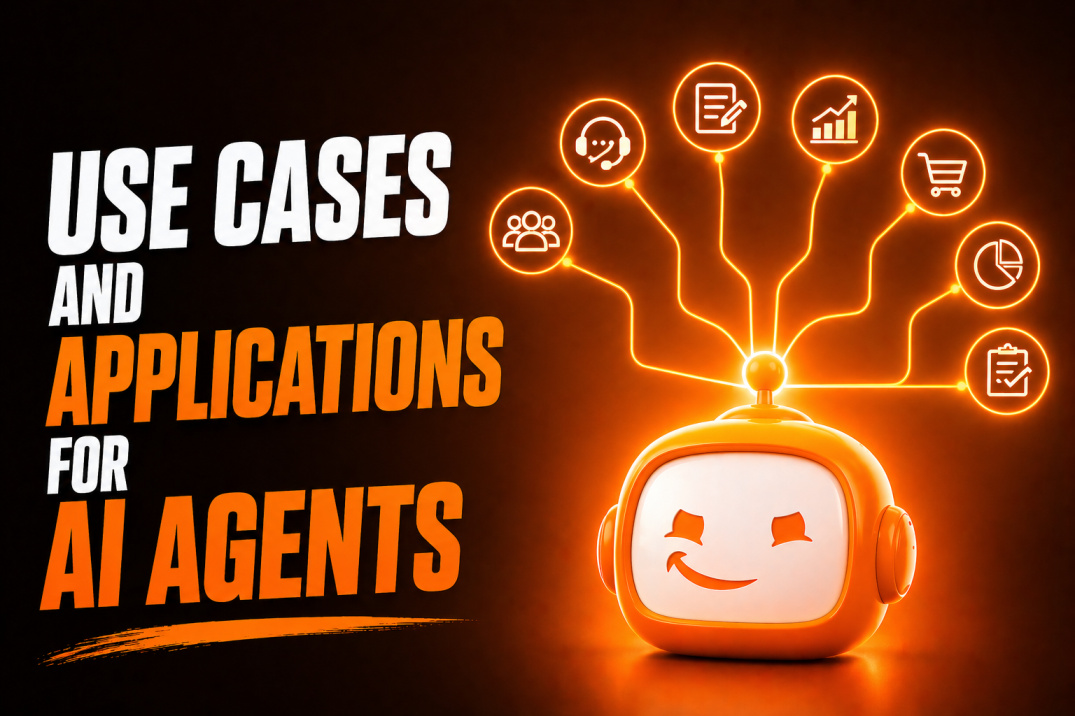
Use Cases and Applications for AI Agents
AI agents have potentially limitless use cases and applications online. Here’s a curated list of the most used applications for AI agents for individuals and businesses.
Personal Productivity and Life Management
AI agents manage email, scheduling, reminders, and daily planning. They coordinate travel bookings and track personal finances. Tasks are handled continuously in the background without constant user input.
Customer Support and Service Operations
Agents handle high volumes of queries, resolve standard issues, and escalate complex cases with context. They provide continuous availability.
This allows businesses to have lower operational costs, faster response times, and improved customer experience through consistent support.
Sales and Marketing Automation
AI agents qualify leads, manage outreach, and execute campaigns. They personalise communication at scale and support conversational commerce.
Recruitment and HR Processes
Agents screen CVs, match candidates, schedule interviews, and support onboarding.
E-commerce and Marketplace Interactions
Agents recommend products, automate purchasing decisions, and support negotiation between buyers and sellers. They optimise inventory and pricing.
Content Creation and Digital Presence
AI agents generate content, manage audience interactions, and maintain a consistent voice across platforms.
Enterprise Workflow Automation
Agents automate internal processes, perform data analysis, and coordinate across departments. They support compliance and documentation.
Agent-to-Agent Interactions
AI agents interact directly with other agents. They negotiate, exchange information, and coordinate workflows across systems.
Legacy, Knowledge, and Digital Continuity
AI agents preserve expertise and knowledge. They create interactive representations of individuals or organisations that remain accessible over time.
Zetrix Avatar: The First AI Agent With Identity
Current AI agents face a structural limitation. They lack verifiable identity. Without identity, agents cannot act with authority in real-world contexts.
Avatar addresses this limitation by introducing identity as a foundational layer.
Avatar is designed as an AI system that can represent and act on behalf of a real person, anchored by verifiable credentials on blockchain infrastructure.
It enables agents to execute tasks with authority, not just simulate responses. Identity, execution, and interaction are combined into a single system.
At the core is a Personal Knowledge Model trained on an individual’s data, preferences, and behaviour. This model is deployed as an AI Avatar that can communicate, make decisions, and operate independently within defined boundaries.
This allows:
- Delegation of real tasks such as applications, transactions, and communications
- Verified representation in digital environments
- Trusted agent-to-agent interactions within a secure ecosystem
The result is a system where AI agents move from tools to representatives.
Conclusion
AI agents are becoming a core layer in how work is executed. Their value increases as they move from assistance to action.
The most significant use cases require more than automation. They require trust, accountability, and the ability to act on behalf of real individuals or organisations.
Avatar operationalises this by introducing identity into AI systems. With verified identity, agents can execute tasks, interact with other agents, and participate in economic activity without continuous human input.
This represents a structural shift in digital systems. The primary interface is no longer an application. It becomes the agent acting on behalf of the user.
About the Author
Benjamin Richard
Senior Content Writer and Strategist with 10+ years of experience across the SaaS, technology, web3, and manufacturing industries.